 Gertjan Filarski
Yesterday, I had the honour of serving as host and master of ceremonies at World Digital Preservation Day 2025 in Kanaal30, Utrecht. A hall full of heritage professionals, archivists, programmers, artists, and data strategists looked at me expectantly. I opened with a photo of a man few people recognised. To me, he is a hero.
“Who knows who this is?”
No one.
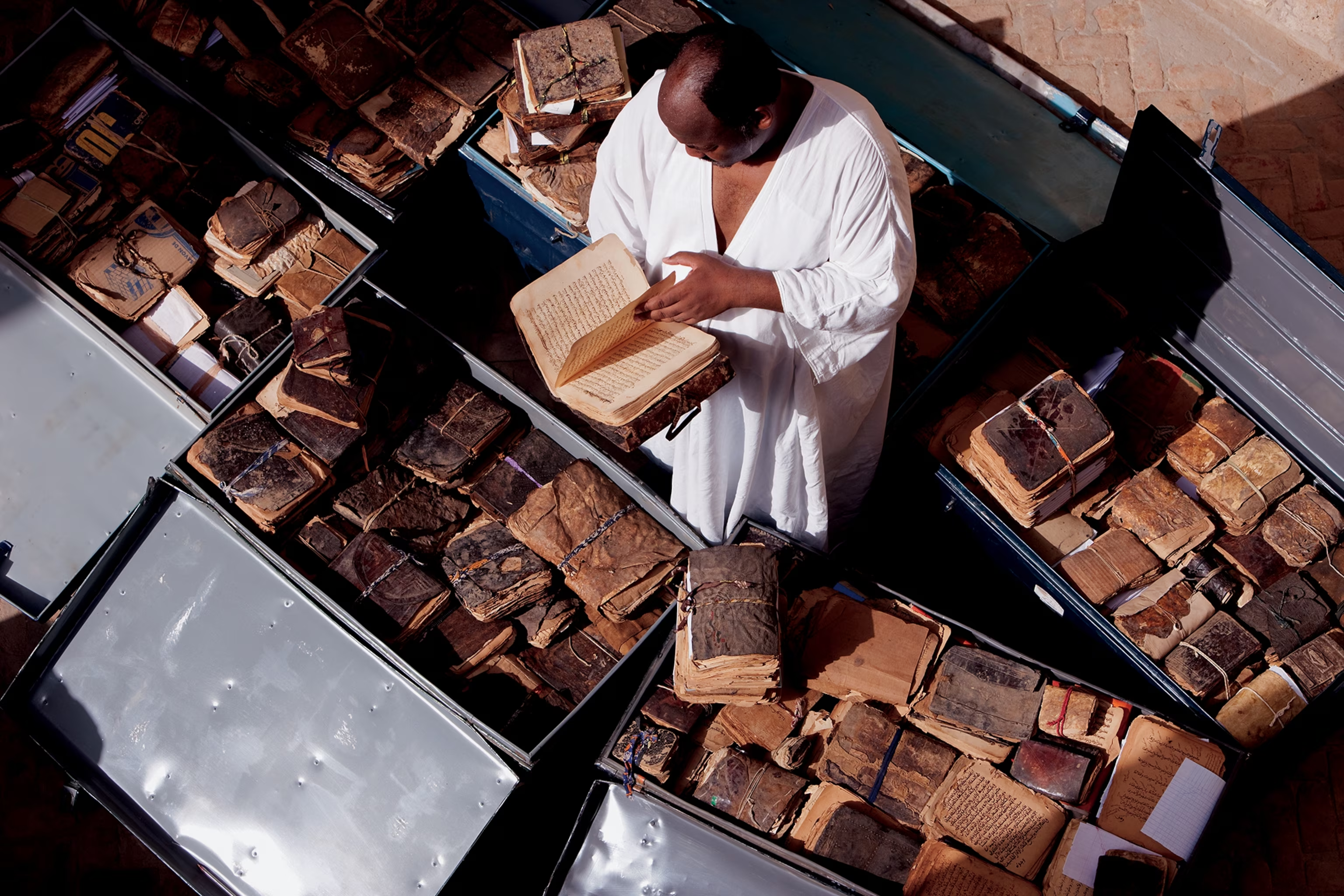
Abdel Kader Haidara. The librarian from Timbuktu who, in 2012, when Al Qaeda jihadists occupied his city, organised the rescue of more than 375,000 manuscripts.
I told his story. About how volunteers secretly smuggled centuries-old books — full of science, poetry, and philosophy — right under the noses of armed militias. About how Dutch funds quietly helped with money and logistics. And how, within ninety days, almost all manuscripts from the desert city were safely stored in Mali’s capital, Bamako.
Not as a hero’s tale, but as a lesson in urgency.
Why Preserve?
That was the theme. And the answers didn’t come in definitions or policy papers, but in the form of stories — from people who preserve as an act of freedom, of resistance against those who want you to forget.
Once in Bamako, a long-term digitisation project began, co-funded by Google. A large part of this digital collection is searchable on Google Arts & Culture.
And this summer, the first 200 crates of manuscripts returned to Timbuktu after thirteen years in exile. The news made headlines in The Guardian and AP News. But in the Netherlands, it remained quiet. No front pages, no television. And yet we were part of the rescue. That is why, as host of this World Day, I wanted to break the silence — to honour Haidara and all librarians of the desert.
A Day Full of Connections
After that beginning, the day unfolded into a whirlwind of ideas, demonstrations, and discussions. From Utrecht we connected live with Ghent and joined a vlog from New Zealand, where iPRES 2025 was taking place. In the video interview, Matthias Priem from meemoo spoke about heritage on disappearing islands — a literally sinking archive. The question “Why Preserve?” suddenly felt less academic and more existential.
New Launches, Old Hardware
The first premieres of the day brought together technology and nostalgia.
LI-MA launched the Amiga How-To Series: Who Cares for Amiga Artworks? — a guide for media artists who want to rescue their floppy-disk era. Next came the launch of Cloud ViPER, an open-source tool for secure cloud storage, developed by the Open Preservation Foundation and funded by the Dutch Netwerk Digitaal Erfgoed.
The contrast was sharp but therefore powerful: from the dusty floppy to the virtual cloud, everything deserves care, context, and continuity.
Sessions with Substance and Character
The rest of the day became a relay of insights.
Rebecca Prinsen (National Archives) and Gijs Meijer (DEN) explained how cybersecurity and digital preservation are two sides of the same coin. Tijm Lanjouw and Simon Saldner presented the 3D reconstruction of vanished Vlooienburg — a neighbourhood digitally reborn.
After lunch, Daniel Steinmeier and Julia van der Knaap took us on a down-to-earth exploration of AI Beyond the Hype, while Jasper Snoeren and Lieven Heeremans shared why podcasts are worth preserving: sound as a cultural mirror.
Later in the afternoon, Barbara Sierman traced the history and future of the OAIS model, and Marissa Memelink from SETUP showed how the Facebook Museum became a space for digital mourning — a meta-archive of our social lives.
The final sessions explored the outer edges of preservation: from VR theatre experiences to linked-data projects that reunite dispersed archives, such as that of Castle Amerongen.
And in between? Humor, quizzes, and vintage gaming in the game room brought by Bart van den Akker of the HomeComputerMuseum. We were rickrolled during the recurring musical parody by Remco van Veenendaal — because digital preservation isn’t all serious business :)
The Power of Community
At the end of the day, just before the closing drinks, I handed out the rotating trophy for the sustainability quiz, drew the bingo prizes, and thanked the many people who made this day possible: the programme committee, the Netwerk Digitaal Erfgoed team, the Flemish colleagues, and of course everyone who shared knowledge, code, or coffee.
What this day showed is that digital preservation isn’t about technology alone. It’s about responsibility — about the willingness to safeguard what has meaning, whether that’s a medieval manuscript, a VR performance, or a tweet.
Epilogue
I ended the day where I had begun that morning: with Abdel Kader Haidara. His work shows that preservation is not merely a technical issue but a moral compass.
Whoever preserves, believes in the future.